Choosing foundation or concealer should not feel like guessing a colour from a screen.
The right complexion product should disappear into your skin, even out what you want to correct and still leave you looking like yourself.
Whether your goal is to reduce the appearance of redness, dark circles, uneven tone, visible imperfections or simply create a more polished complexion, choosing the right product comes down to four things:
- Your skin-tone depth
- Your undertone
- Your skin type
- What you actually want to correct
This complete VMEN’S guide explains each step and helps you narrow down your ideal foundation and concealer shade without making complexion makeup complicated.
First: Foundation and Concealer Do Different Jobs
Although they are often used together, foundation and concealer are not interchangeable.
Foundation
Foundation is designed to create a more even-looking complexion across larger areas of the face.
VMEN’S Foundation with Peptides for Men provides buildable coverage with a natural semi-matte finish. It can visually balance uneven tone, redness, visible pores and imperfections while still allowing the natural dimension of the skin to remain visible.
The objective is not to cover your entire face with a visible layer of makeup. A well-matched foundation should blend into the skin so naturally that the colour itself is difficult to detect.

Concealer
Concealer is more targeted.
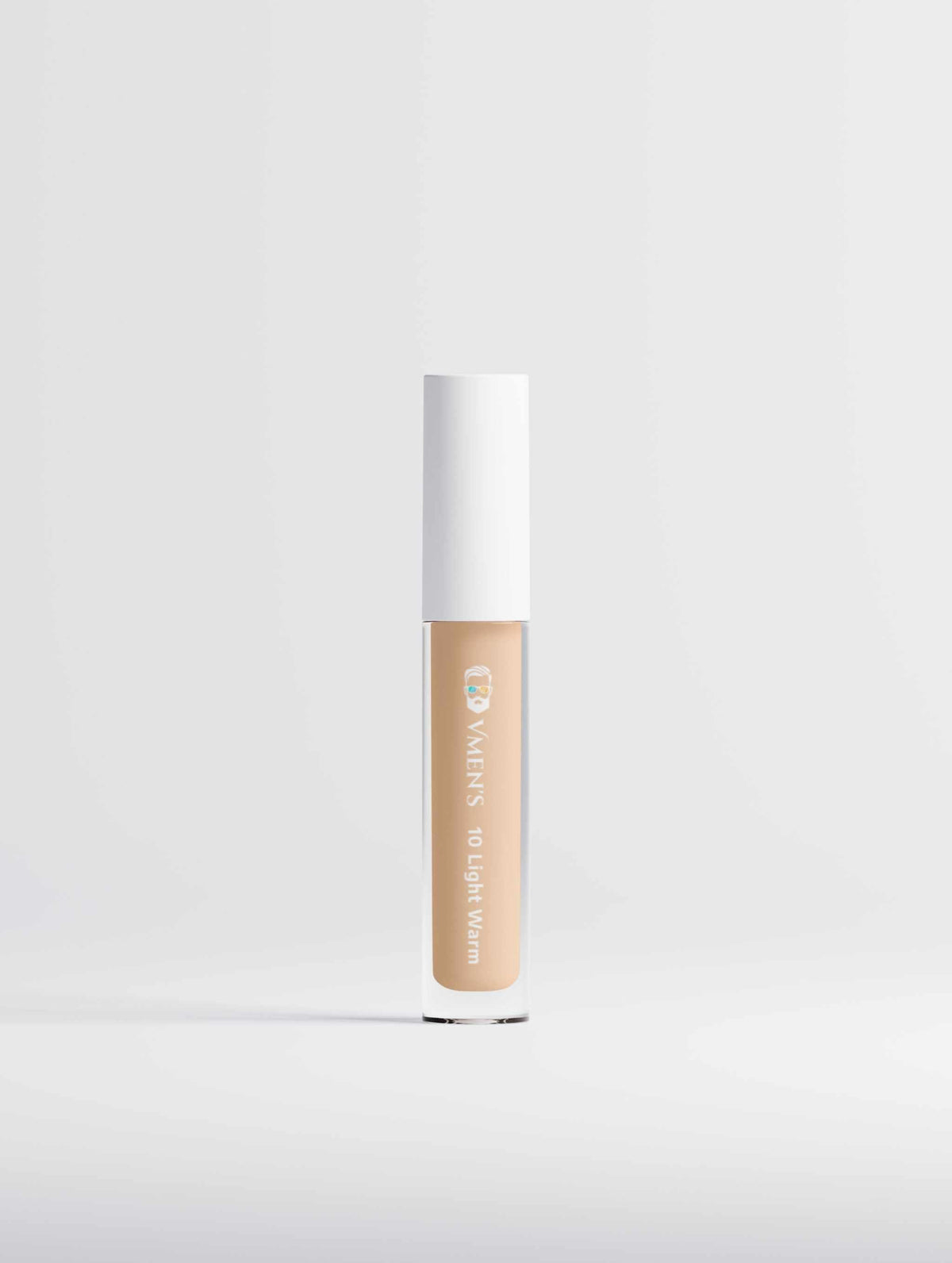
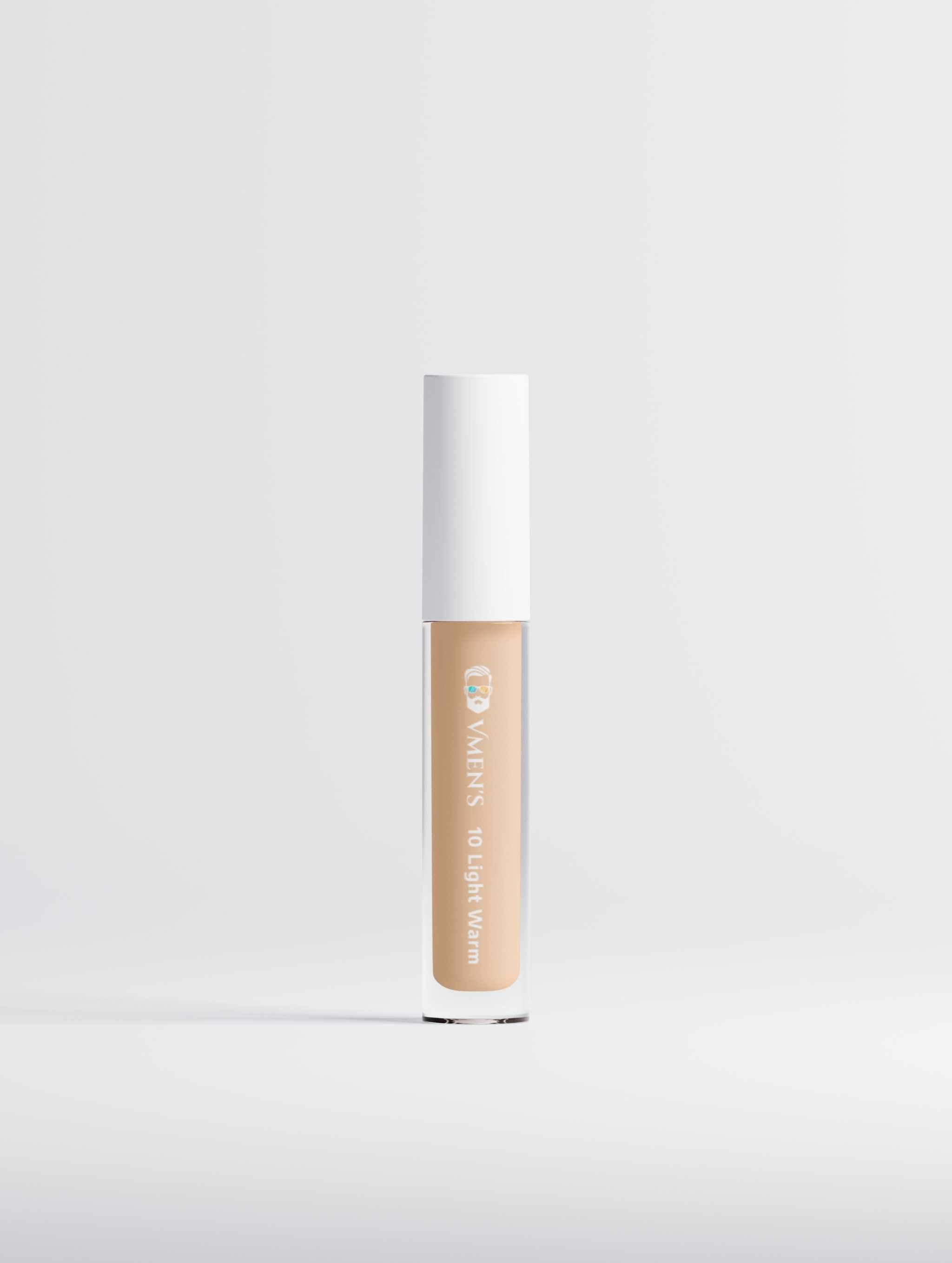
VMEN’S Correcting Concealer for Men is designed for areas where you want additional correction, such as:
- Dark circles
- Signs of fatigue
- Redness around the nose
- Blemishes
- Post-blemish marks
- Small areas of uneven pigmentation
Its creamy, hydrating formula contains ingredients including Hyaluronic Acid, Aloe Juice, Shea Butter and Sodium PCA to help maintain a comfortable, skin-like finish.

Step 1: Identify Your Skin-Tone Depth
Skin tone refers primarily to how light or deep the visible surface colour of your skin is.
Do not confuse this with undertone — we will get to that next.
VMEN’S foundation shades move through five broad depth families:
- Fair — very light skin
- Light — light skin
- Medium — medium-depth skin
- Tan — deeper sun-kissed or naturally tan skin
- Deep — deep skin tones
Look at your face, jaw and neck together rather than looking only at your forehead or cheeks.
The centre of the face can naturally be lighter or redder than the outer face, while the neck may give a more reliable indication of your overall complexion.
VMEN’S Foundation Shade Depths
| Shade | Depth | Undertone |
|---|---|---|
| 05 Fair Neutral | Fair | Neutral |
| 10 Light Warm | Light | Warm |
| 15 Light Cool | Light | Cool |
| 20 Medium Neutral | Medium | Neutral |
| 25 Medium Warm | Medium | Warm |
| 30 Tan Neutral | Tan | Neutral |
| 35 Tan Warm | Tan | Warm |
| 40 Deep Neutral | Deep | Neutral |
| 45 Deep Warm | Deep | Warm |
| 50 Deep Cool | Deep | Cool |
Step 2: Find Your Undertone
This is where shade matching becomes much more accurate.
Your skin tone can change throughout the year as you tan or lose a tan. Your undertone usually remains much more consistent.
The three undertone groups used in the VMEN’S complexion range are cool, warm and neutral.
Cool Undertone
Cool skin can show pink, reddish or slightly bluish undertones.
You may notice:
- Skin tends to appear more pink than golden
- Blue or purple veins may be more visible
- Silver jewellery may look particularly natural against the skin
- Very yellow foundation shades can look noticeably wrong
VMEN’S cool foundation options include 15 Light Cool and 50 Deep Cool.
Warm Undertone
Warm undertones can appear golden, peach, yellow or softly olive.
You may notice:
- Your skin looks naturally golden rather than pink
- Veins may appear slightly greener
- Gold jewellery often complements the skin naturally
- Cool pink-based products may look slightly grey against your complexion
VMEN’S warm foundation shades include 10 Light Warm, 25 Medium Warm, 35 Tan Warm and 45 Deep Warm.
Neutral Undertone
Neutral undertones sit somewhere between warm and cool.
You may not see an obvious pink or golden cast in your skin, or you may see elements of both.
VMEN’S neutral foundation shades include 05 Fair Neutral, 20 Medium Neutral, 30 Tan Neutral and 40 Deep Neutral.

How to Check Your Undertone More Reliably
No single undertone test is perfect.
The popular “look at your veins” method can help, but lighting, vein depth and natural pigmentation can all affect what you see. A better approach is to combine several clues.
1. Compare Pink and Golden Colours
Hold something distinctly pink-toned and something warm beige or golden next to your face in daylight.
If warm colours harmonise more naturally, you may have a warm undertone. If pinker colours look more natural, you may lean cool.
2. Look at Your Neck and Jaw
Redness in the cheeks can make cool undertones appear stronger than they really are. Your jaw and neck often give you a better overall reference.
3. Use Natural Daylight
Bathroom lighting can dramatically change how colour looks. Whenever possible, evaluate your shade near a window in indirect daylight.
4. Do Not Choose a Foundation to Correct Redness
If your skin becomes red easily, you may be tempted to buy a much warmer or yellower foundation to cancel it out. That can create an obvious colour difference between your face and neck.
Your foundation should match your underlying complexion. Localised redness can then be corrected separately with concealer.
Step 3: Test Foundation in the Right Place
The back of your hand is one of the least reliable places to test foundation.
Your hands and face are often different colours because of sun exposure, circulation and natural pigmentation.
Instead, test foundation along the lower cheek and jawline. Apply a small amount and blend it slightly toward the neck.
The best shade should visually disappear rather than sit as a lighter, darker, pinker or more yellow patch on your skin.
The Three-Stripe Method
- Apply three small vertical stripes along the jaw.
- Blend the edges slightly.
- Look at them in natural daylight.
- Choose the shade that becomes the least noticeable.
If you can clearly see the foundation colour sitting on top of your skin, it is probably not your best match.
Step 4: Choose Concealer Based on What You Want It to Do
Concealer shade selection changes depending on its purpose.
For Blemishes, Redness and Dark Spots
Choose a concealer that is as close as possible to your natural skin tone or foundation. A concealer that is significantly lighter may actually highlight the blemish you were trying to hide.
For Under-Eye Brightening
You can choose a concealer approximately one depth lighter than your complexion for a subtly brighter appearance.
Keep the undertone reasonably compatible with your skin. Going dramatically lighter can make the eye area appear grey or visibly made-up instead of naturally rested.
VMEN’S Correcting Concealer Shades
| Shade | Depth | Undertone |
|---|---|---|
| 05 Light Cool | Light | Cool |
| 10 Light Warm | Light | Warm |
| 15 Medium Cool | Medium | Cool |
| 20 Medium Warm | Medium | Warm |
| 25 Medium Neutral | Medium | Neutral |
| 30 Tan Neutral | Tan | Neutral |
| 35 Deep Neutral | Deep | Neutral |

Does Skin Type Change Which Shade You Need?
No. Skin type does not determine your colour, but it can significantly affect how foundation and concealer look once applied.
Dry Skin
Hydration is essential. Apply moisturiser before complexion products and allow it to settle. Avoid applying excessive foundation to dry or flaky areas because pigment can emphasise texture.
Start with a very small amount and build only where needed.
Oily Skin
Use lighter skincare layers underneath and give them time to absorb before applying makeup.
VMEN’S Foundation with Peptides has a natural semi-matte finish, making it suitable for creating a refined complexion without an overly dewy appearance.
Rather than applying a heavy layer immediately, build thin layers where additional correction is required.
Combination Skin
Treat different areas differently. You may require more hydration around the cheeks but much less product through the forehead, nose and chin.
Foundation does not need to be applied equally across the entire face.
Sensitive Skin
Keep preparation simple and avoid introducing several new skincare products immediately before makeup.
Both VMEN’S Foundation with Peptides and Correcting Concealer are positioned for all skin types and sensitive skin.
How Much Foundation Should Men Use?
Usually less than you think.
The modern approach to men's complexion makeup is not about creating an opaque layer.
Start with a small amount around areas where uneven tone tends to be most visible:
- Around the nose
- Centre of the cheeks
- Chin
- Between the brows
Blend outward toward the edges of the face. Areas that already look even may not need foundation at all.
This selective approach creates a much more natural result.
How to Apply Foundation So It Does Not Look Like Makeup
With Your Fingers
Fingers work particularly well when you want very natural coverage. The warmth of your hands can help blend the product into the skin.
Use tapping and pressing motions rather than aggressively rubbing the product around the face.
With a Damp Sponge
A damp complexion sponge can create soft, diffused coverage. Press the product into the skin rather than dragging it.
With a Brush
A brush is useful when you want slightly more polished or controlled coverage. Finish by pressing over the application with clean fingers or a sponge if you want to soften any visible edges.
How to Apply Concealer Under the Eyes
More concealer does not automatically mean better coverage.
The skin around the eye is thin and naturally moves throughout the day, so heavy application can become more noticeable.
Instead:
- Place a very small amount near the inner under-eye area where darkness is usually strongest.
- Add a second tiny amount only where necessary.
- Tap gently with your ring finger, brush or sponge.
- Blend outward.
- Add another layer only if you genuinely need it.
This creates a fresher result while allowing the skin to remain visible.
Foundation vs Concealer: Which One Do You Actually Need?
You may not need both.
Choose Concealer Alone If:
- Your overall complexion is already even
- You mainly want to hide dark circles
- You have one or two blemishes
- You want the most minimal possible routine
Choose Foundation If:
- You have general redness
- Your complexion looks uneven across larger areas
- You want pores and imperfections to appear softer
- You want a more uniformly polished complexion
Use Both If:
You want foundation to create an even base and concealer only where additional correction is required.
Apply foundation first. You may discover that you need significantly less concealer afterwards.
The Most Common Foundation Mistakes
Choosing a Shade That Is Too Dark to Look More Tanned
Foundation is not bronzer. A foundation that is darker than your natural complexion can create an obvious line around the jaw and hairline.
Match your natural complexion first. Add warmth separately if desired.
Choosing a Shade That Is Too Light
A foundation that is too pale can make the complexion appear flat or grey, especially in photographs.
Ignoring Undertone
Two products can have almost identical depth but look completely different because one is warm and the other cool.
Applying Too Much Product
Coverage should be built gradually. A thin first layer almost always looks more natural than beginning with maximum coverage.
Stopping at the Jawline Without Blending
You should not need to cover your neck with foundation. If the colour is correct, simply softening the edge around the jaw should create a seamless transition.
What If You Are Between Two Shades?
This is completely normal.
Your complexion is not a fixed colour throughout the year. Sun exposure can move your visible skin tone lighter or darker while your undertone remains similar.
If you are genuinely between two shades, choose according to your current complexion rather than the shade you normally wear in another season.
Some people maintain two nearby shades and adjust between them throughout the year.
A Simple VMEN’S Shade-Matching Formula
If all of this feels complicated, remember this:
Step 1 — Find your depth.
Fair, Light, Medium, Tan or Deep.
Step 2 — Find your undertone.
Cool, Warm or Neutral.
Step 3 — Match foundation to your jaw and neck.
Step 4 — Choose concealer based on purpose.
Match your complexion for blemishes. Go subtly lighter for under-eye brightening.
Step 5 — Start with less product than you think you need.
That is the foundation of natural-looking complexion makeup.
Frequently Asked Questions
Should men's foundation be lighter or darker than the skin?
Neither. Foundation should match your natural complexion as closely as possible. Using foundation to make the skin appear lighter or more tanned usually makes the product more visible.
Where should I test foundation?
Test foundation along the lower cheek and jawline and compare it with both your face and neck in natural daylight.
How do I know whether I have a warm, cool or neutral undertone?
Look at several indicators rather than relying on one test. Compare how pink and golden colours sit against your complexion, observe the jaw and neck in daylight and notice whether your skin naturally appears more pink, golden or balanced between the two.
Should concealer be lighter than foundation?
For blemishes and local imperfections, choose a shade close to your natural complexion. For subtle under-eye brightening, a concealer around one depth lighter can work well.
Can I wear concealer without foundation?
Yes. If your overall skin tone is relatively even, applying concealer only to dark circles, redness or individual imperfections can create an extremely natural result.
Can men with facial hair use foundation?
Yes. Use less product around beard growth and blend with the direction of the hair rather than applying a heavy layer over facial hair.
Is foundation suitable for sensitive skin?
VMEN’S Foundation with Peptides is designed for all skin types and is positioned as sensitive-skin friendly. If your skin is particularly reactive, patch testing a new cosmetic product remains a sensible precaution.
What finish looks most natural on men?
A skin-like finish that avoids being extremely matte or excessively glossy tends to be the least noticeable. VMEN’S Foundation with Peptides provides a natural semi-matte finish with buildable coverage.
Find Your VMEN’S Shade
Complexion makeup should not change who you see in the mirror. It should simply give you control over what remains visible.
Start by understanding your skin depth and undertone, choose the amount of coverage you actually need and build slowly.
The best foundation shade is not the shade people notice.
It is the one they do not notice at all.